How and Why?
About PatientView
Why we do it
PatientView is a UK-based research, publishing, and consultancy group, created out of a belief that the views of patients should be considered in all important healthcare decisions (whether a new healthcare product is being developed, or whether a government is instituting changes to a health system). The organisation was formed in response to the emerging powerful new global patient movement. PatientView has worked to build bridges worldwide between pharmaceutical companies and health NGOs that comprise the patient movement—to help define and support one of the most important factors changing healthcare in the 21st century.
Key assets we bring:
- Independence: The research undertaken by PatientView for its portfolio of products is solely funded by PatientView itself.
- Unique datasets: PatientView draws on the diverse insights supplied to it by many thousands of patient groups worldwide—allowing for the creation of meaningful metrics for pharmaceutical companies.
- Objective and impartial advice from patient groups important to your company: PatientView works at gaining unbiased evaluation of how patient groups perceive your company’s performance, and its engagement with patient groups and patients. The patient groups also supply PatientView with invaluable information on how companies like your own can improve.
- Worldwide engagement of patient groups: PatientView operates in 23 languages, to ensure truly-global response rates from patient groups.
How we do it
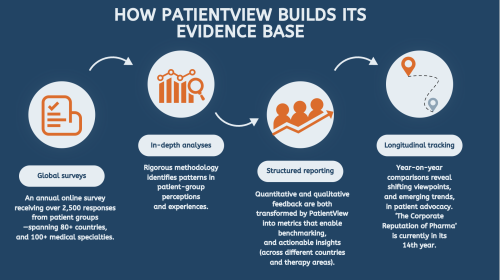
Our products and services rely on the participation of patient groups. PatientView has a powerful reach, with listings of some 40,000 patient groups worldwide, from most therapy areas, and almost every country worldwide.
For over 10 years, we have built up a trusted relationship that allows us to conduct online questionnaires with senior managers in each organisation. We work in over 20 languages to ensure we accurately represent the views of all countries’ groups, including the very important verbatim quotes that provide additional context.
We aim to provide consistent data sets so that historic datasets are possible.