World Prostate Cancer Day 2026: The need for improved global screening
June 2026:
Prostate cancer remains one of the most significant global health challenges. It is the most frequently diagnosed cancer in men in 112 countries, and the leading cause of cancer death among men in 48 countries. In 2022 alone, there were approximately 1.47 million new cases and 397,000 deaths globally [1]. By 2040, it is predicted that the incidence and deaths will nearly double, largely due to population growth and ageing [2].
With June 11th marking World Prostate Cancer Day, it is an important moment to reflect on the scale of the disease, and the urgent need to improve early detection, diagnosis and equitable access to care across the world.
New screening recommendations in the UK
As with many types of cancer, early detection drastically improves outcomes in prostate cancer. The Prostate-Specific Antigen (PSA) blood test is commonly used as a first-line investigation, followed by magnetic resonance imaging (MRI) and biopsy when needed [3].
Unlike other common cancers, prostate cancer has no national screening program in the UK. In May 2026, the UK National Screening Committee (UK NSC) published its final recommendation against population-wide PSA screening for all men [4]. This decision reflects ongoing concerns about false positives from PSA testing and the risk of unnecessary biopsies. Instead, the UK NSC recommended a targeted screening approach. Men aged 41-61 with the BRCA2 gene variant and relevant family history will be offered a PSA test every two years.
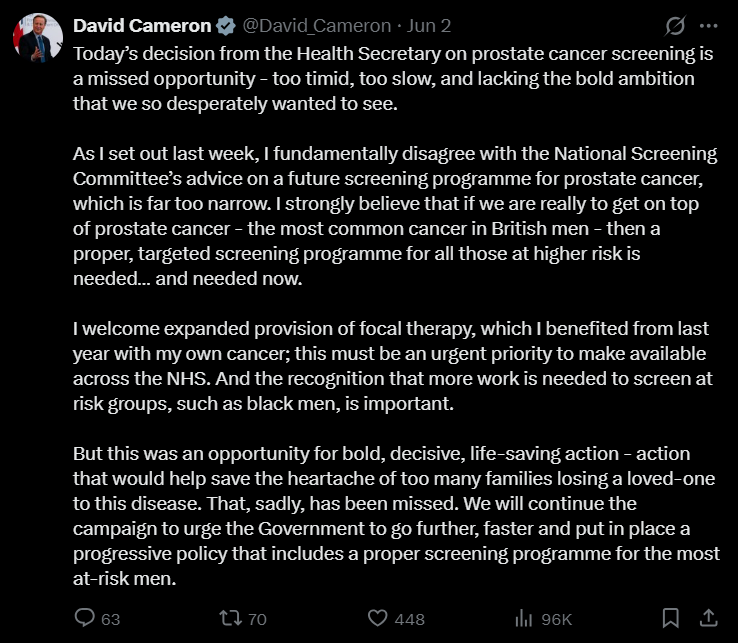
The UK government officially accepted the UK NSC’s final recommendations on June 2nd 2026. The decision to bring in targeted screening, as opposed to a wider national program, has sparked wide debate across the UK. While targeted screening may reduce harms associated with overdiagnosis, many clinicians and patient advocates continue to argue that a broader programme is needed to improve early detection at scale.
The TRANSFORM trial: Redefining prostate cancer screening
Alongside policy developments, the UK is investing in research to improve how prostate cancer is detected. Prostate Cancer UK’s TRANSFORM trial, launched in 2024, is one of the most ambitious screening studies ever undertaken for the disease. Its goal is to identify the most effective and safest approach to prostate cancer screening, with the long-term ambition of inviting all men at risk for regular testing.
Stage one of the trial will enrol approximately 16,000 men and compare a range of screening tools, including MRI scans, genetic testing and PSA blood tests. These approaches will be evaluated against the current NHS pathway, where there is no organised national screening and men must request a PSA test. Stage two of the trial will expand to around 300,000 participants, allowing researchers to assess the most promising method at scale, including its benefits and potential harms.
Men aged 45–74 are being invited to participate in the trial. Prostate Cancer UK has committed to a goal of at least 1 in 10 participants being black men, who have a significantly higher risk of developing prostate cancer. Efforts are also being made to include men from deprived and rural communities, as well as those with disabilities.
In addition to its clinical aims, TRANSFORM will generate an unprecedented biobank of samples, imaging, and data, creating a valuable resource for future research and innovation. Prostate Cancer UK organised TRANSFORM in partnership with the NHS, the National Institute for Health and Care Research (NIHR) and the UK Government. Prostate Cancer UK has committed £26 million to the trial, and £16 million was initially received in government funding. A further £18 million announced in June 2026 by the UK government brings the total project investment to £60 million [5].
How does the UK compare globally when it comes to prostate cancer screening?
Globally, there are large disparities in prostate cancer screening, reflecting wide differences in healthcare systems, resources and national priorities. Outside of the UK, the rest of Europe is a global leader in prostate cancer screening, with a shift towards organized, risk-adapted frameworks. The EU is funding a project run by the European Association of Urologists, named PRAISE-U (Prostate cancer Awareness and Initiative for Screening in the European Union). The project aims to standardise prostate cancer screening protocols across EU Member States, with the use of PSA testing followed by risk-stratification to determine if an MRI is needed. The three-year pilot and research phase ended in April 2026, with pilots run in Ireland, Poland, Lithuania and Spain. According to preliminary data from PRAISE-U studies, PSA testing and risk assessment can successfully reduce MRI referrals by 40-60% [6].
A growing call for global action
Given the geographic disparities in approaches to prostate cancer screening, the Global Action on Men’s Health has called for an international initiative spanning the full patient journey, from prevention through to palliative care [7].
Key priorities include:
- Stronger government leadership: National prostate cancer strategies, or specific provisions within broader cancer plans, supported by clear key performance indicators (KPIs).
- Education and awareness: Campaigns to improve understanding and tackle stigma surrounding prostate health.
- Improved early detection: The development of organised, evidence-based screening programmes.
- Focus on high-risk groups: Targeted efforts to support men at greatest risk, including Black men, those with a family history, and individuals from lower socio-economic backgrounds.
- Equitable access to care: Timely, affordable access to effective treatments, supported by multidisciplinary teams and psychosocial care.
- Sustained investment: Greater funding for research, infrastructure, workforce development, and treatment access. This is particularly needed in lower-income countries where mortality rates remain disproportionately high.
What comes next?
While progress is certainly being made in prostate cancer, particularly in research and targeted screening, significant gaps remain in early diagnosis and equitable access to care. Advances from large-scale trials like TRANSFORM, combined with international initiatives such as PRAISE-U, offer hope for more effective and personalised screening strategies, sustained political commitment and investment to translate into better outcomes for patients everywhere.
References
[1] “https://www.wcrf.org/preventing-cancer/cancer-statistics/prostate-cancer-statistics/.” .
[2] F. Chu et al., “Global burden of prostate cancer: age-period-cohort analysis from 1990 to 2021 and projections until 2040,” World J. Surg. Oncol., vol. 23, no. 1, p. 98, Mar. 2025 .doi:10.1186/s12957-025-03733-1.
[3] H. Van Poppel, T. Albreht, P. Basu, R. Hogenhout, S. Collen, and M. Roobol, “Serum PSA-based early detection of prostate cancer in Europe and globally: past, present and future,” Nat. Rev. Urol., vol. 19, no. 9, pp. 562–572, Sep. 2022 .doi:10.1038/s41585-022-00638-6.
[4] “https://view-health-screening-recommendations.service.gov.uk/prostate-cancer/.” .
[5] “https://prostatecanceruk.org/about-us/news-and-views/2026/06/extra-18m-for-transform-to-reach-screening .” .
[6] “https://uroweb.org/news/research-presented-at-international-urology-conference-in-london-shows-how-far-prostate-cancer-screening-has-come.” .
[7] “https://gamh.org/prostatecancer-global/.” .
A note from PatientView
The prostate cancer patient movement has grown significantly in the face of all the above-named challenges. PatientView numbers close to 100 unique prostate cancer patient groups in its own database, from 32 different countries: Australia, Belgium, Canada, Costa Rica, Cyprus, Czech Republic, Denmark, Finland, France, Germany, Greece, Israel, Italy, Japan, Lithuania, Malaysia, Mexico, Netherlands, New Zealand, Norway, Poland, Portugal, Singapore, Slovenia, South Africa, Spain, Sweden, Switzerland, Taiwan, UK, USA.
For more on the prostate cancer patient movement, please contact [email protected]